

Keep your aquarium cool in summer heat – easy ways to cool your aquarium with surface agitation, aquarium chiller and better temperature control to prevent overheating during a heat wave #
Summer can be one of the most challenging times of the year for any aquarium. High air temperatures, intense sunlight, and heat generated by lighting and equipment can gradually raise the water temperature. This affects both freshwater and saltwater aquariums, although the consequences may vary depending on the type of tank and the organisms living in it. As the temperature rises, it affects the amount of dissolved oxygen in the water, the metabolism of fish and other organisms, and the biological stability of the tank. In a freshwater aquarium, excessive temperatures can negatively affect fish and plants, while in a marine aquarium, corals, shrimp, and other invertebrates also require particular attention. For this reason, keeping your aquarium at a safe temperature during the summer heat should not be about rapidly cooling the water. It is far more important to reduce heat sources, improve gas exchange, and maintain a stable aquarium water temperature throughout periods of hot weather.
Freshwater aquarium in summer – how high water temperature can cause a fish tank to overheat #
Most freshwater aquariums perform best at around 23–26°C. During summer, however, the water temperature can often exceed 28°C and may reach 30–32°C in homes without air conditioning. For many species, these temperatures are not immediately fatal, but they can already cause noticeable physiological stress. Fish metabolism speeds up, breathing becomes faster, and their demand for energy and oxygen increases. Fish may spend more time near the surface of the water, move their gill covers more rapidly, become less active, or, conversely, display signs of restlessness. Not all species respond in the same way. Fish originating from cooler environments generally tolerate high temperatures less effectively than tropical fish. Prolonged overheating can also weaken the immune system, increasing susceptibility to bacterial and parasitic infections. There is no single tank temperature that can be considered suitable for every fish and plant species. The target range should always reflect the requirements of the specific livestock. Stability is equally important, as sudden temperature swings can be just as stressful for fish as prolonged exposure to excessively warm water.
Increase surface agitation to improve oxygen levels #
One of the most important changes during summer is the decline in oxygen solubility. Warm water holds less oxygen than cooler water, even though fish, nitrifying bacteria, and plants may require more of it at the same time. For example, water at around 20°C may contain close to 9 mg of oxygen per litre, whereas at 30°C this can fall to around 7 mg/l. The difference may seem small, but in practice it can significantly affect the comfort of the entire tank population. This is why adequate surface agitation, efficient filtration, and good circulation become particularly important during summer. Gentle movement across the water surface improves gas exchange at the surface without requiring intensive aeration around the clock. Higher temperatures also accelerate the metabolism of organisms living in the aquarium. Fish digest food more quickly and produce waste more frequently, while bacteria responsible for breaking down nitrogen compounds also become more active. While this may increase the rate of biological processing, it can also result in greater oxygen consumption and faster accumulation of nitrates and phosphates. During a heat wave, it is therefore sensible to avoid overfeeding. Smaller, more frequent portions are preferable to a single large feeding. If aquarium fish begin spending an unusual amount of time near the surface, breathe rapidly, or show other signs of stress, check the temperature with a thermometer and inspect circulation and filtration. Increasing surface agitationcan improve gas exchange and help maintain adequate oxygen availability.
Aquarium water temperature, plants, algae, and CO₂ #
Contrary to what might be expected, aquatic plants do not always benefit from higher temperatures. Most commonly kept species grow best at around 22–27°C. Above this range, photosynthesis may gradually slow down, particularly when plants have limited access to carbon dioxide or nutrients. At the same time, cellular respiration increases. This means plants use more energy to maintain their basic biological functions, leaving fewer resources available for growth and the development of new leaves.
Possible effects include:
- slower growth,
- smaller and more delicate leaves,
- greater susceptibility to damage,
- easier colonization by algae.
Summer does not necessarily mean fertilization should be reduced completely, but the aquarium should be monitored more carefully. If plants continue to grow vigorously, their demand for macro- and micronutrients may remain high. In strongly lit tanks with CO₂ injection, there may be no reason to reduce fertilizer doses. The situation is different when high temperatures slow plant growth. Excess nitrogen, phosphorus, or micronutrients may remain unused and become available to algae. During summer, monitor plant growth and basic water parameters regularly. Fertilization should reflect the actual needs of the plants rather than follow a fixed routine regardless of conditions. Healthy plants tolerate high temperatures better than specimens already weakened by nutrient deficiencies. A strong root system and sufficient potassium, magnesium, and micronutrients support stable metabolic processes and improve resistance to heat stress.
Summer conditions can also encourage algae growth. #
Higher temperatures accelerate metabolism, greater light availability provides additional energy, and slower plant growth reduces competition for nutrients.
The most commonly observed problems include:
- filamentous algae,
- green dust on the glass,
- green spot algae,
- green water blooms.
The appearance of algae does not automatically indicate a fertilization problem. It may instead be a sign that the balance between light, temperature, CO₂, and nutrients has been disrupted. Higher temperatures also affect CO₂ in the water. Carbon dioxide escapes more readily from the aquarium, especially when there is strong surface agitation. This improves oxygenation but can reduce the amount of CO₂ available to plants. In High-Tech aquariums, a sensible balance between aeration and maintaining an appropriate CO₂ level is therefore important.
Saltwater aquarium in summer – How does high water temperature affect fish, corals, and invertebrates? #
Temperature control is especially important in a marine aquarium. Fish, corals, shrimp, snails, and other invertebrates are adapted to particular environmental conditions, and some species tolerate prolonged overheating or sudden temperature swings poorly. Many tropical marine aquariums are maintained at around 25–26°C, but this should not be treated as a universal range for every tank. The correct water temperature should always be based on the requirements of the species being kept. As the temperature rises, marine fish breathe faster, their metabolism increases, and so does their demand for oxygen. At the same time, the amount of dissolved oxygen decreases. Saltwater can also contain less dissolved oxygen than freshwater at the same temperature, making good circulation and strong movement at the surface of the waterparticularly important during the summer heat.
Corals, invertebrates, and temperature swings #
Corals require particular attention in a marine aquarium. Prolonged heat stress can disrupt their normal functioning and, in more sensitive species, may contribute to the loss of symbiotic zooxanthellae and coral bleaching. This does not mean that one specific water temperature will automatically cause the same response in every aquarium. The coral species, duration of exposure, previous conditions, water quality, and the speed of temperature change all matter. Shrimp, snails, and other invertebrates can also respond poorly to rapid changes in conditions. For this reason, a marine aquarium should not be cooled by suddenly adding very cold water or by using methods that cause abrupt temperature swings. It is safer to lower the temperature gradually and maintain it as consistently as possible.
Evaporation and salinity stability #
Evaporation has an additional consequence in a marine aquarium. Water evaporates, but the dissolved salts remain in the tank. As more water is lost, the salinity of the remaining water increases. This becomes particularly important when adding a fan to cool the tank, because fans intentionally increase evaporation. The water level should therefore be checked and topped up regularly. For top-offs, appropriately prepared RO/DI water should be used rather than additional saltwater. Replacing evaporated water with saltwater would cause salinity to rise further. In larger tanks, an automatic top-off system can be very useful. It replaces small amounts of water as needed, limiting fluctuations in the water leveland helping maintain more stable salinity during periods of intensive evaporation.

Cooling methods – How to cool your aquarium water and lower the temperature safely #
The most important goal is stability. Rapidly cooling the water by adding very cold water or ice can be more dangerous than the elevated temperature itself.
Safer ways to lower the temperature include:
- increase surface agitation,
- use a fan blowing across the surface,
- perform water changes with water at a similar temperature,
- avoid overfeeding fish,
- regularly monitor fish behaviour and plant condition.
A good first step is also to check the equipment. A faulty heater or thermostat may unnecessarily increase the tank temperature. If the lighting system is programmable, reducing the time that aquarium lights operate at full intensity during the hottest part of the day may also help reduce heat. Water changes should not be used to rapidly drop the temperature. Replacement water should be close to the temperature already present in the tank. Adding a large amount of significantly cooler water can cause sudden thermal stress in fish and invertebrates. For the same reason, ice cubes should not be placed directly into the aquarium. In an emergency, a sealed frozen bottle or bag of ice can provide temporary cooling, but only while the temperature is monitored continuously with a thermometer and the water is not allowed to cool too quickly. This should be treated as an emergency measure rather than a routine method of temperature control.
Adding a fan – Evaporative cooling for an aquarium #
One of the simplest ways to lower the temperature is to position a fan so that air moves across the surface of the water. A standard fan can be mounted appropriately, although dedicated aquarium fans designed to attach to the tank rim are usually more convenient. A fan does not cool the water in the same way as a refrigeration unit. Instead, it increases evaporative cooling. Moving air removes humid air from directly above the water surface, increasing evaporation and allowing heat to leave the aquarium. A fan blowing across the surface should be directed over the water rather than down into the tank. If the tank lid is closed, partially opening it or temporarily removing part of it may help, provided this is safe for the livestock. The risk of escaping fish should always be considered, so care must be taken to prevent fish from jumping. This method can lower tank temperature effectively and can also be automated using a thermostat or temperature controller. Its main limitation is increased evaporation, which means the water level must be monitored regularly.
Aquarium chiller – When is a chiller worth using? #
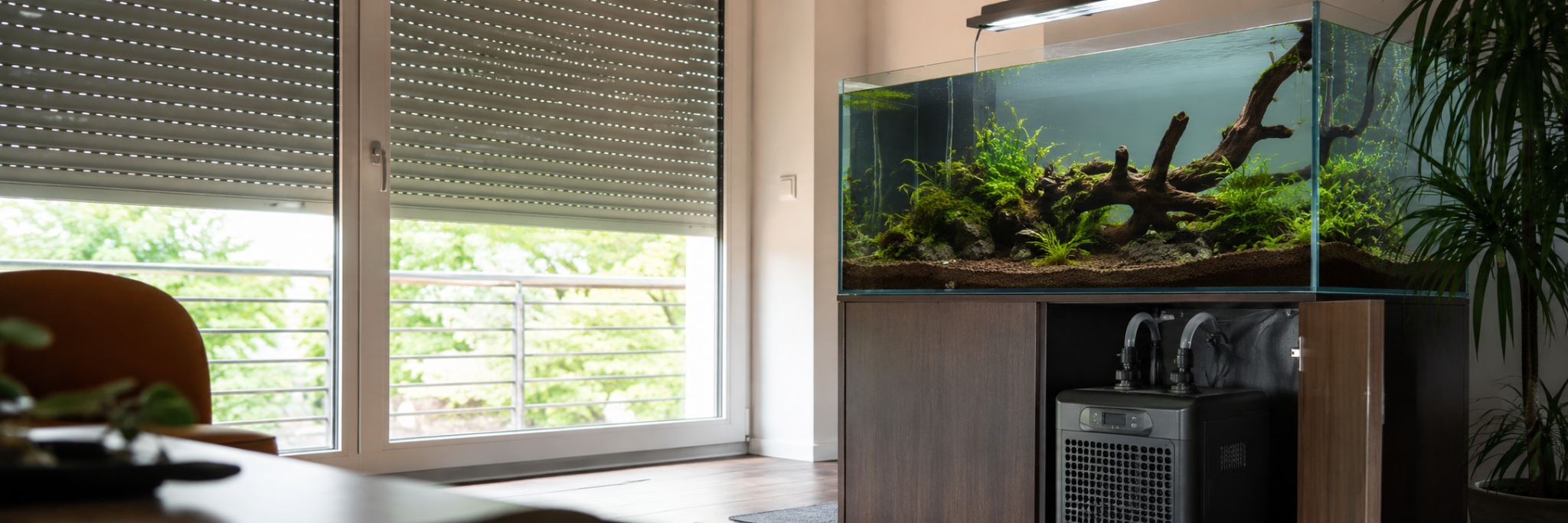
When fans are not enough or the tank requires very stable temperatures, a dedicated aquarium chiller can be used. A chiller removes heat from circulating aquarium water and transfers it to the surrounding environment. The unit works with a pump that provides the required water flow and usually includes a thermostat, allowing it to switch on automatically once the preset water temperature is exceeded. An aquarium chiller can be especially useful in a marine aquarium containing corals and sensitive invertebrates when the ambient room temperature regularly causes the tank to overheat. It can also be useful in larger systems where lighting, pumps, and other equipment act as significant heat sources. This does not mean that every fish tank needs a chiller. If fans are able to keep the water cool and maintain a stable temperature, a more advanced cooling system may not be necessary. When choosing a unit, do not consider tank volume alone. The required aquarium chiller capacity should also account for the ambient room temperature, the desired temperature reduction, water flow, and the amount of heat generated by the equipment.
How to keep your tank water cool during hot weather #
The most effective cooling begins before the water temperature starts rising rapidly. Instead of focusing only on how to cool down aquarium water, it is better to reduce the amount of heat reaching the tank in the first place. This applies to both freshwater and marine aquariums. One of the most common mistakes is placing an aquarium where it receives direct sunlight for several hours a day. Direct sunlight can warm the water further, especially when the tank is positioned next to a sunny window. During a heat wave, this can make it much more difficult to keep the water cool. If the room receives strong sunlight, external blinds are a useful solution. They block part of the solar radiation before it passes through the window, allowing the room to heat up more slowly. As a result, less heat reaches the aquarium water.
External blinds, air conditioning, and ambient room temperature #
Air conditioning can also be highly effective. Reducing the ambient room temperature decreases the amount of heat transferred to the aquarium and reduces the workload placed on fans and the chiller. This becomes particularly important during a severe heat wave, when indoor temperatures remain high for many hours. Combining external blinds, air conditioning, protection from direct sunlight, and control of other heat sources can provide much more stable conditions. The smaller the difference between the target aquarium water temperature and the ambient room temperature, the easier it becomes to prevent the tank from overheating. Regardless of the type of aquarium, the best results usually come from combining several methods: reducing room heat, maintaining good circulation and surface agitation, using fans, and, where necessary, installing an aquarium chiller. Together, these measures allow you to lower the temperature gradually without exposing fish, corals, invertebrates, or plants to sudden temperature swings.