Beginner saltwater aquarium setup: setting up a saltwater aquarium, choosing a reef tank, planning your first reef aquascaping, salt water fish, location, and essential equipment #

Setting up your first saltwater aquarium step by step: planning, maintenance, and getting started with confidence #
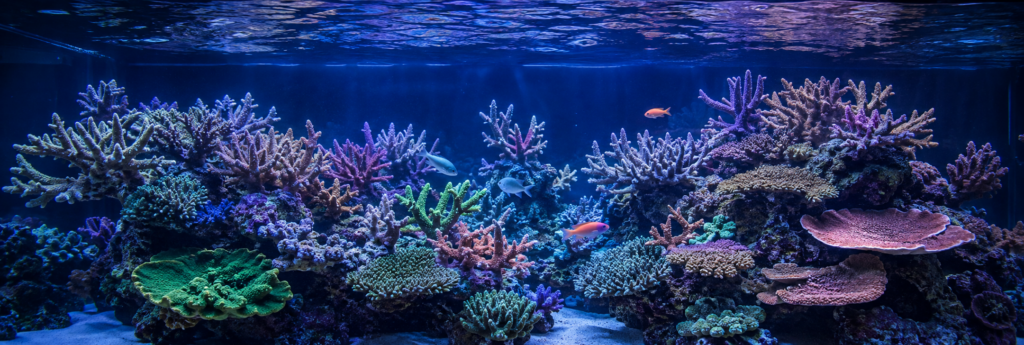
For many people, their first saltwater aquarium marks the beginning of an extraordinary adventure in the aquarium hobby and reef keeping, as well as the fulfillment of a dream of having their own piece of reef at home. Colorful fish, corals, live rock, and the marine atmosphere make a huge impression, but this is also a time when it is easy to make costly mistakes. Before buying a tank, light, rock, or salt, it is worth carefully considering what you want your first saltwater aquarium to look like and what conditions you can provide for it at home.
At the beginning, the most important thing is not which fish or corals will go into the tank, but whether you understand the basics: where to place the aquarium, what capacity to choose, and which equipment will genuinely be necessary to get started. When setting up a saltwater aquarium, you need to remember that it is not merely a decoration, but an environment for living animals that require regular care. At first, this may seem difficult, but over time, aquarium maintenance becomes much easier, more intuitive, and genuinely rewarding. The most important thing is to understand that an aquarium is a closed ecosystem in which every element matters. A stable aquatic environment requires regular monitoring, a properly completed cycle, and gradually gaining experience. For a beginner aquarist, water parameters are just as important as the choice of equipment. A reliable test kit helps monitor ammonia and nitrite levels, while beneficial bacteria support the biological processes that keep the system stable. The correct water temperature, salinity, and later biological filtration all affect whether the water in the aquarium remains stable and safe for its future inhabitants.
Therefore, before you start looking into how to set up a saltwater aquarium, it is worth answering a few simple questions: how much space do you have, what budget do you want to allocate, and are you interested in a small nano reef or a larger tank with more demanding corals? A 30–60-liter nano saltwater aquarium is planned differently from a 250-liter aquarium with a sump and LPS corals, and differently again from an advanced system with SPS corals. It is also worth planning in advance which fish species and marine organisms you want to introduce into the tank. Different animals have different requirements, so the livestock selection should be matched to the size of the aquarium and your ability to maintain it.
Where to begin with your first saltwater tank setup and how to choose the right reef tank #
When setting up a new marine aquarium, it helps to think of the process as building a house: before moving on to the visually impressive elements, you need to plan the foundations carefully. In this case, the foundations are the location, capacity, and essential equipment. If these decisions are well considered from the beginning, maintaining the tank later will be more convenient, and the risk of costly changes will be significantly reduced. It is worth checking in advance whether the aquarium will have a stable base, access to electricity, and enough room for everyday maintenance. A poorly chosen location can quickly become a problem, especially when you need to clean the glass, top up the water, service the equipment, or perform water changes. Moving an established tank is stressful for both the owner and the animals.
When choosing their first tank, many people consider very small tanks because they appear simpler and less expensive. In practice, however, a smaller volume of water means less stability, so a 60 L saltwater aquarium may be more convenient than a 30 L cube, but it still has its limitations. For this reason, a tank of around 90 L is often a more sensible choice for beginners — it is still compact, but provides more room for rock and equipment and allows for more stable maintenance. Such a nano saltwater aquarium allows you to begin without immediately investing in a large reef system, while providing a greater margin of safety than the smallest kits. This is particularly important when planning your first saltwater aquarium and wanting the setup process to be organized, convenient, and as stress-free as possible.
Choosing the right location and cabinet for your first reef tank #
It is worth choosing the location for your first saltwater aquarium before purchasing the tank. The aquarium should be clearly visible, while also being positioned so that everyday maintenance is convenient. The visual effect is not the only consideration; access to electricity, the ability to approach the tank freely, and enough room for basic maintenance tasks are also important. Even a compact aquarium becomes heavy once it is filled with water and rock, sand, and equipment are added. Therefore, the tank should stand on a stable, properly leveled cabinet designed for aquariums, rather than on a random piece of furniture. This is important both for safety and for the later convenience of maintaining the tank. The choice of location affects not only convenience, but also the aquarium’s future maintenance. At the planning stage, it is worth allowing space behind and below the main tank for additional equipment, especially if the system may later include an overflow, return pump, or refugium. This will make it easier to develop the reef aquarium or expand the system with additional devices in the future.
Where to place your saltwater tank for easy maintenance and stable water parameters #
The aquarium should not be placed next to a window, radiator, or in an area exposed to drafts. Direct sunlight can overheat the water and contribute to algae problems, while heat sources or sudden temperature changes make it more difficult to maintain stable conditions. When considering where to place the aquarium, choose a quiet location with the most stable temperature possible.
It is worth leaving enough space around the tank for cleaning the glass, topping up the water, performing water changes, and servicing the equipment. A well-planned location makes saltwater aquarium equipment easier to access and prevents regular maintenance from becoming burdensome. A kit of around 90L all-in-one aquarium, still fits comfortably into a home environment, but like every saltwater aquarium, it requires a stable base and convenient access. It is also worth leaving room for potential expansion, as dosing pumps or other saltwater aquarium equipment may be added over time. This will make future aquarium maintenance much more convenient and ensure that accessing the equipment does not become a problem.
Choosing the right saltwater tank size for your first saltwater aquarium #
The choice of capacity is very important, especially when planning your first saltwater aquarium. A small tank may seem easier because it takes up less space and has a lower initial cost, but in practice, it requires more attention and precision. A smaller volume of water means less stability, so the tank reacts more quickly to every mistake. When choosing a tank, it is worth remembering that every additional liter of water increases the stability of the entire system. A larger volume makes it easier to maintain the correct water parameters and has a positive effect on water quality, which is particularly important during the first few months of maintaining the aquarium.
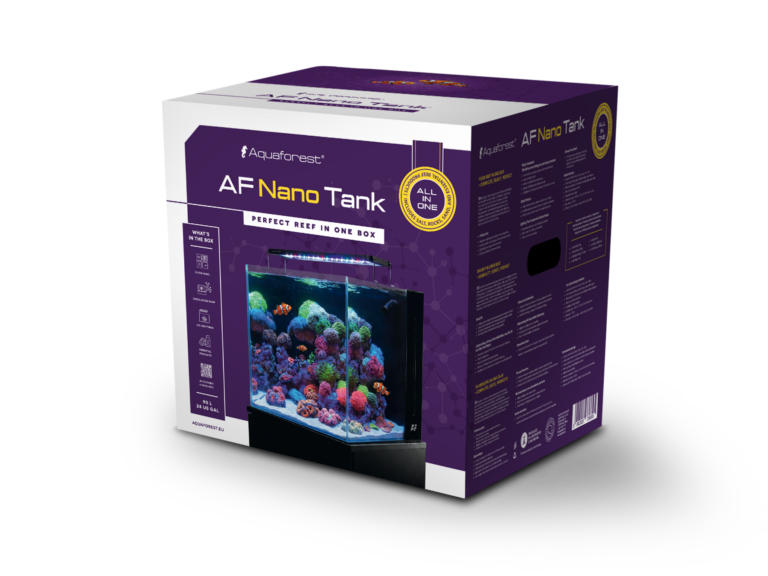
On the other hand, large aquariums provide a greater margin of safety in terms of water parameters, but they also require a larger financial investment, both at the time of purchase and during subsequent maintenance. Therefore, a tank of up to approximately 100 L is a good choice for beginning your saltwater aquarium-keeping journey. The 90 L Aquaforest Nano Tank fits this need particularly well. It is a ready-made 45 × 45 × 45 cm kit containing an aquarium with a filtration panel, a circulation pump, a heater, an LED light, and the products needed to start the tank, including salt, rock, glue, sand, and bacteria. A tank with a capacity of 100 liters or a similarly sized gallon tank is often recommended as an aquarium for beginners because it provides greater stability than the smallest kits and offers more space for future inhabitants.
Why larger saltwater tanks are often a better choice for beginners #
It is more difficult to maintain stable conditions in very small saltwater aquariums. Despite their lower purchase cost, 30-liter tanks are the most vulnerable to fluctuations in temperature, salinity, and other parameters. This can lead to problems with the condition of the livestock, especially while the aquarium is still maturing or when the owner is taking their first steps in saltwater aquarium keeping.
An aquarium of around 90 L is a sensible compromise between compact dimensions and ease of maintenance. It can still function as a nano saltwater aquarium, but it provides more room for rock, basic saltwater aquarium equipment, fish, corals, and a natural aquascape than smaller kits. More space also means more room inside the aquarium, making it easier to arrange the rock and provide better conditions for both fish and corals. For someone beginning their saltwater aquarium-keeping journey, this capacity makes it possible to move through the initial stages more calmly, maintain a functioning aquarium, and enjoy its development instead of struggling with the limitations of an excessively small tank.

Saltwater aquarium filtration: which system best supports biological balance and stable water parameters? #
Filtration in a saltwater aquarium is responsible for maintaining stable conditions and removing the contaminants produced as the tank operates. An efficient filtration system is the heart of the entire aquarium — it largely determines how stable the tank will be and how easy it will be to maintain later. Properly selected aquarium filtration helps preserve biological balance and supports the natural processes taking place in the tank. Particularly for beginners, the right system helps reduce problems caused by the accumulation of contaminants.
In a saltwater aquarium, it is important not only to filter the water mechanically, but also to control compounds such as NO3 and PO4, meaning nitrates and phosphates. Filter media and absorbents are often used to reduce them, and these require sufficient space and the correct water flow. The use of live rock is also very important, as it provides a natural environment for bacteria and helps maintain stable conditions. When combined with appropriate filtration, it makes it possible to create a well-functioning marine ecosystem. In addition to the type of filter itself, proper water circulation is also important because it affects the transport of oxygen and nutrients, as well as the effective operation of the filter media being used.
There are three main filtration systems used in saltwater aquarium keeping: a hang-on-back filter, a filtration panel, and a sump. A hang-on-back filter is usually attached to the rim of the aquarium and may work well in very simple tanks, but it has limited capacity for media and equipment. A filtration panel is a separated section of the aquarium, usually positioned at the back or side of the tank, where filtration and some of the equipment can be concealed. A sump is a separate technical tank, usually located inside the cabinet beneath the aquarium. It provides the greatest filtration possibilities and more space for equipment, but it also requires more room, plumbing, and planning. With any solution, it is worth considering the amount of space available for biological media and the possibility of using additional components such as a protein skimmer. This makes it possible to control the tank’s biological load more effectively, particularly with a larger livestock population.
Filtration panel, filter compartment, or sump: which setup is best for a beginner saltwater tank? #
A hang-on-back filter is the simplest solution because it is attached to the rim of the aquarium and does not require any additional plumbing. It may work well in very small, simple tanks, but it has limited capacity for filter media and usually does not allow equipment to be concealed as conveniently. In a saltwater aquarium, where filter floss, biological media, or PO4 and NO3 absorbents are often used, this space can quickly prove insufficient.
For someone setting up their first saltwater aquarium, a filtration panel is usually the more convenient choice. It makes it possible to organize the filtration system, reduce the amount of visible equipment, and avoid additional plumbing. This is precisely why the Aquaforest Nano Tank has a built-in filtration panel with three chambers and adjustable water inlets — a beginner aquarist has a ready-made space for filtration and can begin their saltwater aquarium journey without the stress of designing the filtration system independently and selecting separate components.
A sump remains a very good solution, particularly in larger and more advanced aquariums where more space is needed for filtration and additional saltwater aquarium equipment. When choosing a system, it is also worth considering the future expansion of the reef aquarium, as a larger amount of technical space makes it easier to install additional devices and provides better control over the parameters of the entire system. For beginners, however, it may unnecessarily complicate the entire project because it requires more space, plumbing, and planning. In the ready-made Aquaforest Nano Tank kit, the essential equipment has already been selected, so there is no need to assemble the components individually or wonder whether they will work together. Regardless of the chosen solution, regularly monitoring the quality of the saltwater is important because even the best filtration system requires proper maintenance and parameter control.
Essential equipment for a saltwater aquarium: lighting, water circulation, and biological filtration #
In a saltwater aquarium, equipment is not an optional extra, but the foundation of the tank’s stable operation. Lighting is responsible not only for the aquarium’s appearance, but also for providing suitable conditions for coral growth and survival. A properly selected light helps create an environment in which corals can thrive while making the aquarium look natural and attractive. It is worth remembering that different coral species have different lighting intensity requirements, so the choice of light should be matched to the planned livestock. The correct light intensity has a direct effect on the condition of the tank’s inhabitants.
Circulation, meaning the movement of water inside the tank, is equally important. It determines whether food, oxygen, and nutrients reach the corals and whether contaminants accumulate in one location. If the flow is too weak or poorly directed, dead spots develop — areas where the water barely moves and where food remains and detritus begin to accumulate on the bottom and between the rocks. Proper flow helps keep the aquarium clean and reduces the accumulation of unwanted substances between the rocks. Effective gas exchange also supports stable conditions for all organisms living in the tank.
Filtration removes contaminants and helps maintain a stable environment, but it works most effectively when the water circulates properly throughout the entire aquarium. At the beginning, there is no need to invest immediately in advanced controllers, reactors, or dosing pumps. Properly selected essential equipment is far more important: lighting, heating, circulation, and efficient filtration.
What equipment do you need for a saltwater fish tank before fish and corals? #
At the start, you primarily need equipment that provides enough light for coral growth, a stable temperature, proper water movement, and effective filtration. In the AF Nano Tank kit, these functions are provided by an LED light with adjustable power, a night mode, and a timer, a quiet 1000 L/h circulation pump, a 150 W heater, and a built-in filtration panel with three chambers and adjustable water inlets. In addition to the equipment itself, materials are also needed to start the tank correctly: marine salt, rock, sand, bacteria, and media that support biological filtration. In the AF Nano Tank kit, this part of the setup is made easier by AF Reef Salt, AF Nano Rock, AF BioSand, AF BioS bacteria, and AF Life Bio Fil and AF Life Source filter media — products selected for the initial startup of the aquarium. Preparing the right water for a saltwater aquarium is also very important because its quality affects the subsequent operation of the entire system. Reverse osmosis water must be used to reduce the amount of unwanted compounds before preparing the saltwater mixture.
A well-selected set of saltwater aquarium equipment and startup materials makes the beginning smooth and organized. With the AF Nano Tank, there is no need to select the light, pump, heater, filtration, rock, sand, or salt separately, or to worry about whether the equipment has been chosen correctly and will operate effectively. The essential components are already matched to the tank, making it easier to start calmly and reducing the risk of random choices. This allows you to focus on starting the aquarium correctly and watching the new underwater world develop.

The first step toward creating your own reef aquarium at home #
A well-planned first saltwater aquarium begins with several sensible decisions: choosing the location, the right capacity, filtration, and essential equipment. These factors affect the convenience of maintenance, the stability of the tank, and the comfort of caring for the animals later. The Aquaforest Nano Tank can make this first stage easier because the most important components have already been selected for the aquarium. Such a kit organizes the setup process, reduces the risk of choosing equipment at random, and makes it possible to move more calmly from planning to starting the tank. It is worth remembering that even a ready-made kit will later require regular monitoring of aquarium parameters and observation to ensure that all elements of the aquarium ecosystem are functioning correctly.
Setting up a saltwater aquarium step by step: what comes after choosing the tank location and essential equipment? #
Once the location, capacity, and essential equipment have been carefully considered, the next step is to plan and glue together the rock structure, known as aquascaping. This is an important stage because the rock arrangement affects not only the appearance of the aquarium, but also the amount of space available for future corals and fish and the unrestricted flow of water. Properly designed saltwater aquarium aquascaping makes it possible to create a natural environment in which the inhabitants have enough room to live and hide. Proper rock placement also makes subsequent tank maintenance easier.
In the next article, we will focus on how to prepare such an arrangement step by step: how to choose the rock, plan its placement, connect the elements into a stable structure, and select the sand so that the entire setup is attractive, safe, and convenient to maintain as the reef aquarium develops.